Meet Your Relationship and Trauma Therapist in Brooklyn, NY

A Space To Hold All Your Feelings
I believe that healing comes from sharing and making space for all of parts of you despite how messy and complicated they may seem. You may struggle with feeling seen by those around you and feeling chronically disconnected by the relationships in your life.
As a relationship and trauma therapist, I’m curious to learn how your past experiences have shaped the current understanding you have about yourself and the ways you move through the world. Together we will explore the old patterns that are no longer serving you in order to build new ones that attract the connection, intimacy, and emotional safety that you need and desire.
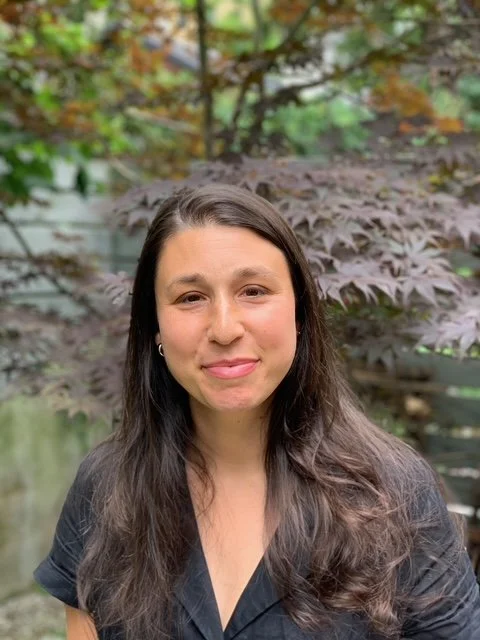
About Me
I’m Hannah, a relationship and trauma therapist who helps individuals and couples untangle old patterns of relating that are no longer serving them. I work from a relational and psychodynamic perspective with a particular focus on attachment style. I will help you explore the way that you are showing up in your relationships with romantic partners, family, and friends. In our work you will come to understand how your earliest attachments in childhood have shaped you. Did you grow up in a household where you felt seen and understood by your family? Did you feel as though people believed you and honored your experiences? I believe that healing starts in the therapy relationship; repairing old wounds, building new pathways, and feeling assured that you can take up all the space you need.
Using a trauma informed approach, I will help you to process painful experiences from your past that are causing you to feel stuck, overwhelmed, and anxious. Together we will explore the ways that you have felt unsafe in the past. Perhaps you have endured sexual or physical abuse, a traumatic loss, a history of neglect, or the diagnosis of an illness. Or maybe growing up, your household just simply didn’t feel like a safe place for you to be. You felt like you wanted to hide, to shrink yourself, or even disappear. As we explore your trauma, we will also identify the ways it is showing up in your body. Do you notice tightness in your chest, clenching in your jaw, stomachaches, chronic fatigue? We will go at your pace; always prioritizing your comfort and emotional safety.
Credentials & Training
Masters of Social Work, Silberman School of Social Work at Hunter College
Certificate in Relational Psychotherapy, The Stephen Mitchell Center for Relational Psychotherapy
Licensed Clinical Social Worker in New York
New York License #: 087785
NPI #: 1760850226
I work with adult individuals and couples who are:
Healing from trauma (both acute events and ongoing, chronic traumatic experiences)
Feeling disconnected in their relationships with others
Having fears of abandonment in their intimate relationships
Having difficulty being vulnerable and open with others; often avoiding emotional intimacy
Experiencing chronic feelings of anxiety and hypervigilance
Having difficulty trusting others and experiencing the world as a scary place
Struggling to communicate their needs and boundaries with others
Experiencing conflict in relationship with partner around life transitions, intimacy, and infidelity.
Who I Serve

How I work
As a relationship and trauma therapist, I draw upon several different approaches to best meet the needs of my clients. These are some of the modalities I most frequently use in my work:
Psychodynamic therapy: a type of therapy that focuses on unconscious thoughts, past experiences from childhood, and thought patterns to better understand the way the individual shows up in their current adult relationships.
Internal Family Systems (IFS): focusing on the belief that we all contain different “parts” of our identity. In using this framework, I will help you to cultivate compassion and understanding for your many parts, rather than feeling shame about them.
Attachment-based therapy: focusing on your earliest attachments in childhood and helping you to build awareness around how those early relationships impact your ability to connect with others in adulthood. This modality can be helpful in understanding one’s attachment style in order to better attract partners who meet their emotional needs.
Somatic therapy: this modality is helpful in addressing trauma. It focuses on the mind/body connection and increases self-awareness around bodily sensations and triggers related to an individual’s trauma experience. Clients will be better able to regulate their nervous system through understanding where stress, anxiety, and tension show up in their bodies.
Emotionally Focused therapy (EFT): this modality is particularly helpful in couples work. It helps partners understand their communication style and understand the problematic patterns that might be preventing them from experiencing intimacy and connection in their relationship.
My Values
Curiosity
We slow down to get curious about the nuances of your specific experience and why you feel and behave in the ways that you do.
Inclusivity
I work from the understanding that your lived experience is informed by race, class, ability, gender and sexual orientation.
Collaboration
I play an active role in your sessions and readily provide insights and reflections to help guide you in the direction you are seeking. I am your partner in this work; you don’t have to do it alone.
Therapy with me is…
Collaborative. I am an active and dynamic participant in our sessions
A space where all parts of you are welcome to exist— even the conflicting parts of you that you may not fully accept or understand
Focused on the present and the past. It is equally important to look backwards as it is focus on the here and now
Insight and goal oriented. Providing you awareness of your issues, while also offering concreate tools and strategies to help you get unstuck and find relief
Intersectional. Bringing keen awareness to the many facets of your humanity: your race, class, sexuality, gender, ability, and age and how they impact you.
Therapy with me is not…
One sided. You do all the talking and I sit back and observe. I believe change happens when you can receive feedback and insights in real time
Judgmental. A space where we celebrate certain parts of you and reject others
Focused on the past and only prioritize discussing your childhood and early life
Insight only. Awareness is helpful, but without discussion of a plan forward it can leave you feeling stuck and overwhelmed
One dimensional. There are so many parts of your identity worth exploring. There is the ability to explore all of them.